
Read Idaho County Property Tax Records
Two offices shape every Idaho County property tax record. The Assessor sets market-value assessments and maintains ownership and plat information. The Treasurer bills and collects the tax that follows. Read the current assessment notice and the tax bill together, since each one tells only part of the story.
| Field | What It Shows | Where |
|---|---|---|
| Land value | Assessor's land component | Parcel record |
| Improvement value | Tax-year improvement component | Parcel record |
| Exemption and net | Reduction and remaining taxable value | Assessment record |
| Tax bill and status | Amount, year, installments, payment | Treasurer |
| Tax area | District combination affecting levy | Parcel and bill |
Idaho assesses property at market value. Exemptions can reduce taxable value, though. Neither the assessed amount nor the tax bill equals the property's sale price.
January 1 Starts Idaho County's Assessment Year
The Idaho County Assessor runs a five-year reappraisal cycle. The cycle starts with a January 1 assessment date. Each value belongs to its stated roll year. Later construction, corrections, or exemptions may show up on a different notice entirely.
Check the important-dates page every year. Exemption and appeal tasks follow statutory calendars that do not bend.
The Idaho County Tax Calendar Has Five Checkpoints
The researched calendar combines January 1 assessment, April 15 exemption timing, the fourth Monday in June contest deadline, December 20 first-half payment, and June 20 second-half payment the following year. Mixing these events can turn an assessment question into a payment error.
The Treasurer's property-tax FAQ explains installments, payment methods, delinquency, exemptions, appeals, and bills.
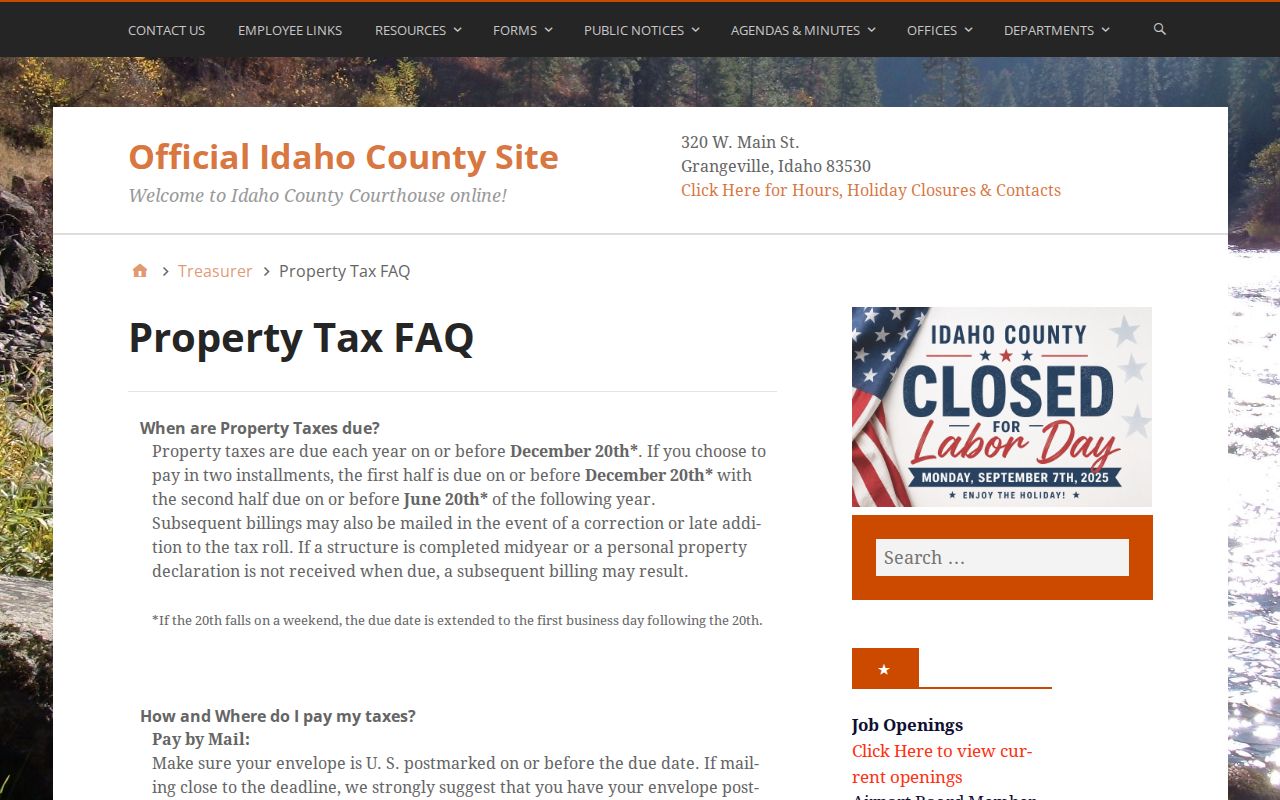
The FAQ offers a plain orientation to the county tax calendar. Confirm the live page and the parcel's current bill before acting on any due date or balance.
Look Up an Idaho County Tax Bill
Start with the parcel ID in the county map. Then open the Treasurer's "Taxes Due" route from the official Treasurer page. Paying online takes the bill number, amount, and tax year through the linked vendor.
- Locate the exact parcel and copy its PID/APN and tax area.
- Match the tax year and bill number before reviewing amounts.
- Compare the land, improvement, exemption, and net assessment fields.
- Separate current installments from delinquency or enforcement records.
- Assessed value
- The value placed on the assessment roll.
- Levy
- Rates from applicable taxing districts used in the bill calculation.
- Homeowner exemption
- Qualified owner-occupied relief that reduces taxable value.
- Tax lien
- A legal claim arising from unpaid property tax.
Read Land, Improvements, Exemption, and Net
The Idaho County Parcel Viewer lays out land, improvement, total, exemption, and net values. Each parcel gets its own line. The viewer also shows the tax area. An update date appears too. Use the GIS map for discovery. Then confirm any contested figure with the Assessor before you rely on it.
The Assessor's official page describes the office responsibilities behind these Idaho County property records.
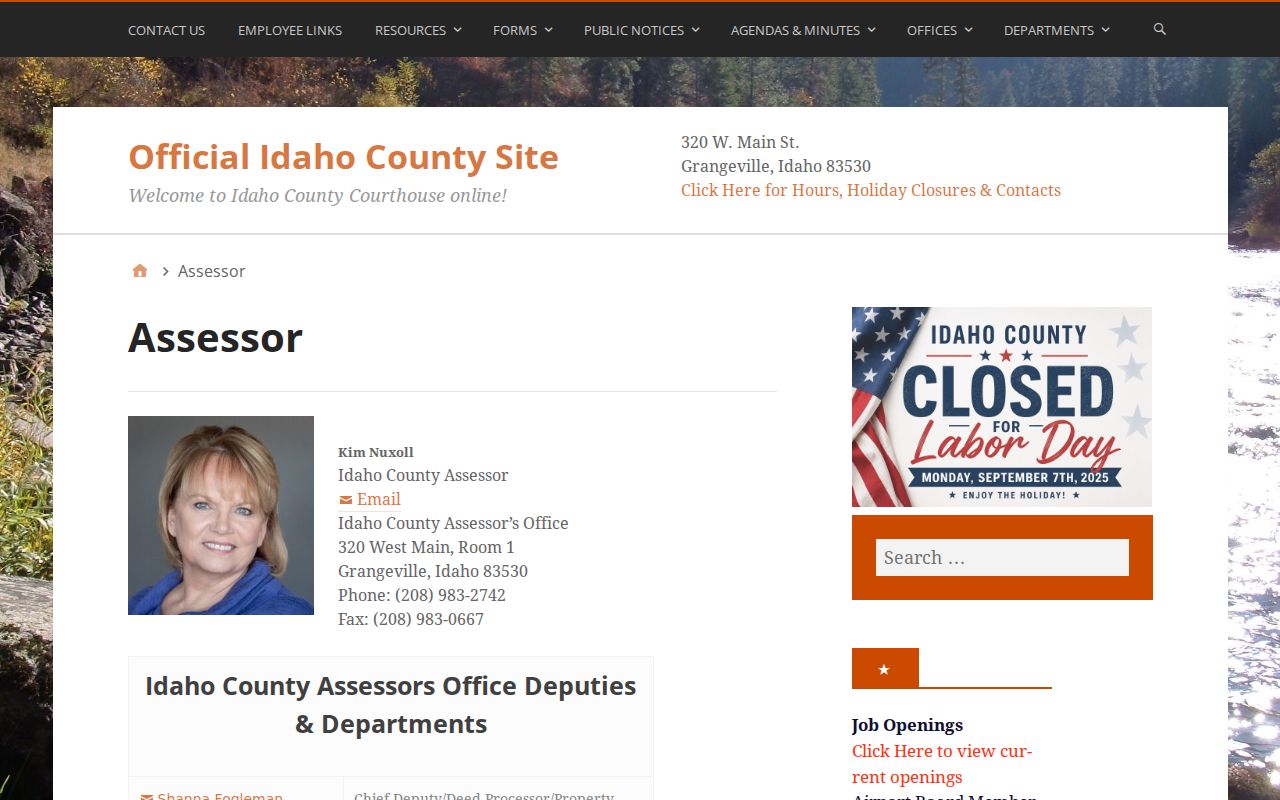
The Assessor's office page is the authoritative route for roll questions, exemptions, and assessment procedure. Any screen image is orientation only, not a substitute for the live source.
Idaho County Exemptions Follow a Separate Decision
Homeowner, Circuit Breaker, and hardship relief each stand apart from payment plans and appeals. Check eligibility and application rules with the Assessor and the Idaho Tax Commission homeowner-exemption guidance. An exemption shifts taxable value. It does not change the parcel's market-value conclusion.
Keep the application, decision, assessment notice, and bill for the same year together. That single-year file settles most confusion later.
Delinquency Is Not the Same as a Sale
Delinquency unfolds in stages. A late installment and a tax lien are early signals. The distraint process, an advertised sale, a certificate, a redemption period, and a final deed are later steps. The Sheriff Civil Division routes tax warrants and civil process. Still, a delinquent bill alone never proves a completed transfer.
For a foreclosure-related ownership question, reconcile the Treasurer's status with court orders. Then check the sale documents and the recorded deed. A public notice is not the final instrument.
Four Idaho County Rolls Explain Midyear Changes
The Assessor works through four rolls: real property, personal property, occupancy, and subsequent. These are not four versions of one list. The real-property roll covers land and improvements. Personal property follows a separate declaration track. An occupancy roll can add newly completed improvements. A subsequent roll carries later additions or corrections. That is why a parcel card and a bill can differ. They may refer to different rolls or years.
The county calendar sets the rhythm. Personal-property declarations are due March 15. Ordinary assessment notices mail the first Monday in June. Contests on those are due the fourth Monday in June. Subsequent-roll notices go out the second Monday in November. Contests on those close the first Monday in December. Read the heading and year on the actual notice rather than transferring one deadline to another roll.
Note: Before alleging an error, identify the parcel, roll, tax year, exemption status, and update date shown on each record.
Translate Idaho County Tax Vocabulary Before Comparing Numbers
Market value: the Assessor's estimate of property value. It reflects the assessment date under Idaho's system.
Assessed value: the value carried on the applicable assessment roll.
Exemption: qualifying value removed from the taxable calculation; it does not rewrite the market-value estimate.
Tax levy or rate: the combined effect of taxing districts applied to taxable value.
Tax lien: a legal claim tied to unpaid tax. It is not proof that a sale or deed transfer has finished.
Idaho's state property-tax overview explains how assessors estimate value from sales and property characteristics. Multiple taxing districts feed the total rate. The Idaho County bill then applies the district structure and parcel account details. A bill can change because of value, exemption, district, or rate shifts. Compare each component rather than blaming the assessment alone.
Assessed-per-acre figures help with orientation. They are not a sale appraisal. Across parcels with different improvements, access, land classes, or exemptions, they can mislead. A last sale amount found in an instrument is yet another distinct number. It may reflect circumstances no roll reveals.
Build a Reproducible Idaho County Tax Lookup
- Find the exact parcel ID in the county viewer using address, owner, parcel number, PLSS, or subdivision.
- Copy the site and mailing addresses separately, along with tax area, legal description, and update date.
- Open the Treasurer's official Taxes Due route and match the parcel or bill details.
- Record the bill number, tax year, first- and second-half amounts, payment status, and any delinquency notation.
- Compare the bill with the same year's assessment notice and exemption decision.
- Save the receipt or contact the Treasurer when a vendor confirmation does not appear on the county account.
The payment vendor asks for a bill number, an amount, and a tax year. Nothing else will do. An owner-name search helps you find the right parcel. It cannot safely carry a payment by itself. If a rural address is blank or newly assigned, lean on the APN and the legal description instead, then check with the Mapping office on whether the situs address has reached county systems yet.
| Lookup field | Why preserve it | Source |
|---|---|---|
| Parcel ID | Links map, roll, and account | Parcel Viewer |
| Tax year | Prevents cross-year comparison | Bill and notice |
| Tax area | Explains district context | Parcel record |
| Exemption value | Explains taxable-value reduction | Assessment record |
| Bill number and amount | Supports payment-vendor lookup | Treasurer bill |
Separate an Exemption Application From a Value Appeal
Four procedures sit apart from each other. These are the homeowner exemption, Circuit Breaker relief, hardship relief, and a valuation appeal. The Idaho Tax Commission homeowner exemption guidance lays out the state framework. Parcel-level applications and assessment questions go to the Idaho County Assessor. Remember what an approval actually does. It changes taxable value. Yet it does not mean the Assessor conceded the market value was wrong.
An appeal file should include the current notice and the correct parcel identification. Add photographs dated near the assessment date. Include corrections to property characteristics, acreage or legal-description evidence, and sales that are genuinely comparable. Factual errors belong with the Assessor first. After that, follow the Board of Equalization instructions and the current filing calendar. A payment disagreement goes to the Treasurer instead. That route never stretches the deadline for contesting an assessment.
Calendar limit. The ordinary Idaho County assessment contest deadline is the fourth Monday in June; verify the current notice and instructions rather than relying on a remembered date.
When a record request becomes necessary, name the parcel, the roll, the year, the notice, and the format you want. The county form still carries legacy fee language, so confirm current copy charges with the custodian. The Attorney General's Idaho Public Records Law guidance is worth consulting too.
Contest an Idaho County Assessment
Begin with the assessment notice. Verify the parcel and the roll year. Then contact the Assessor about factual errors or comparable evidence before anything else. If the dispute survives that conversation, follow the current Board of Equalization procedure and its filing instructions.
Evidence worth gathering includes correct acreage, accurate property characteristics, dated photographs, relevant comparable sales, and any documents showing an exemption or classification error. A tax-payment dispute is a separate track entirely. It does not substitute for a valuation appeal.
Appeal window. Idaho County assessment notices may be contested by the fourth Monday in June. Verify the current notice and filing requirements before relying on a calendar date.
Keep Value and Payment Evidence Together
A solid Idaho County property tax record file keeps the parcel popup, the assessment notice, the exemption decision, the tax bill, and the payment receipt in one place. Any Board order belongs in that file too. Note where each item came from. Web links and ArcGIS data can shift over time, so dating your copies pays off.
For help reading owner clues, continue to Idaho County property search. For deed clues, see Idaho County deed records. A tax bill alone proves nothing about title. Neither does a GIS popup. Fee-simple ownership rests on the deed record, not the tax roll.